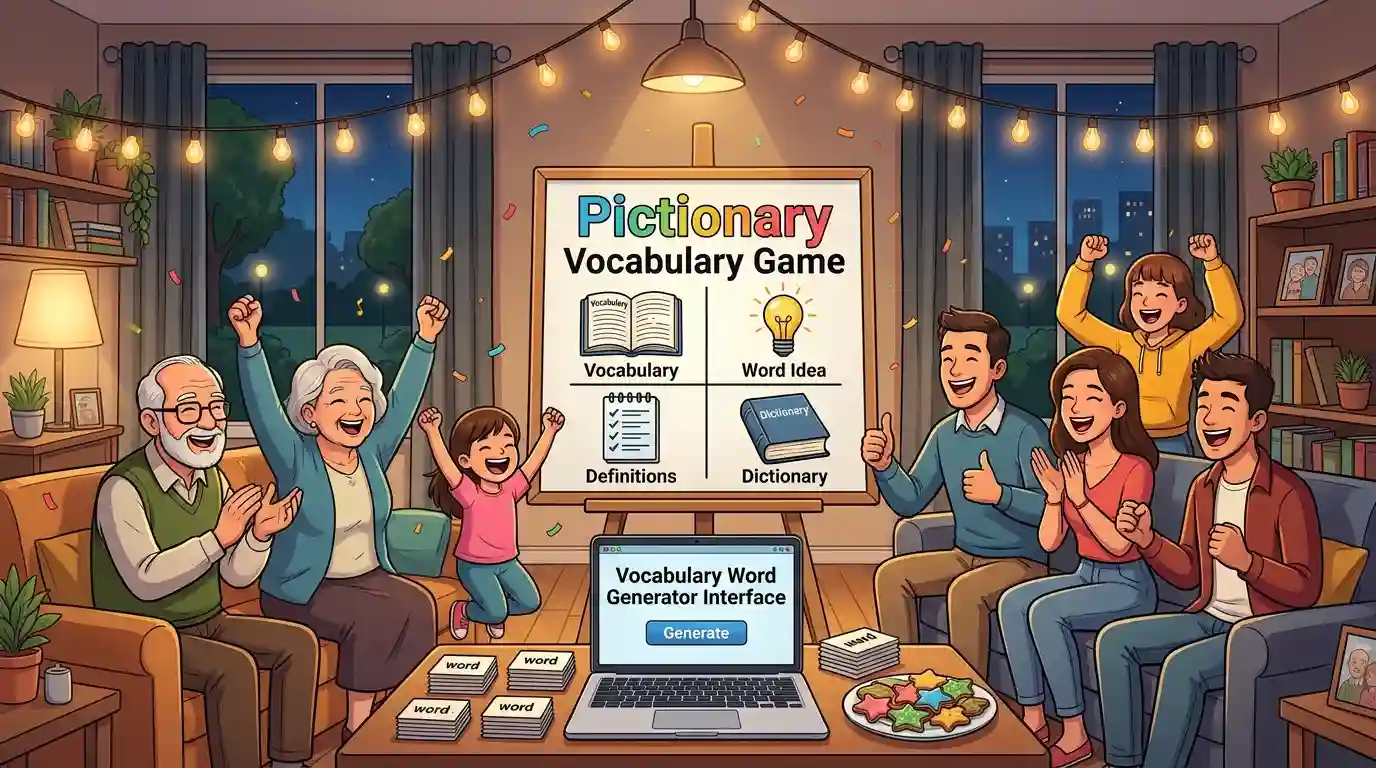
A Pictionary vocabulary game turns a word list into a drawing contest. One student sketches a term and the team races to name it. It suits spelling lists, science units, ESL lessons, and test review. You only need a board, markers, and a timer.
A vocabulary Pictionary game works best with a ready list. Need words fast? Open our free Pictionary word generator. It gives random words by level and category, and it has a timer and a sketch pad for quick rounds.
Why a Vocabulary Pictionary Game Works
Drawing a word helps students remember it. The University of Waterloo reported that people often recalled more than twice as many drawn words as written words. Participants had 40 seconds per word, and the benefit still showed when they had only 4 seconds to draw (University of Waterloo news, April 2016, published in the Quarterly Journal of Experimental Psychology).
The game adds three more benefits.
- Students must show what a word means, not only how it is spelled.
- Guessers say the word out loud again and again, which helps ESL students.
- Every learner joins. Visual learners draw, and verbal learners shine as guessers.
How to Play the Pictionary Vocabulary Game
What you need. A whiteboard or chalkboard, markers or chalk, a timer, a score sheet, and a list of 20 to 40 vocabulary words.
- Split the class into two or three teams.
- One student from the first team comes to the board.
- Show that student one word in private.
- Start a 60 second timer.
- The drawer sketches while teammates call out guesses.
- A correct guess earns a point. Then the next team sends a drawer.
- Play until every student has drawn once, or until a team reaches 10 points.
Drawing rules. No letters, numbers, or symbols. No talking, mouthing, or hand signs. No drawing things that only sound like the word. Notebooks stay closed.
Two ways to score. In team turns, only the drawing team guesses, which keeps the room calmer. In a free for all, every team guesses at once, and the first correct team scores. Each team can send a drawer for the same word, so nobody waits.
Choose Words by Level
The Council of Europe describes the CEFR as a six level scale from A1 to C2, and many ESL courses use it (Council of Europe). The timers below are our suggestions, not rules.
| Level | CEFR | Word type | Timer |
|---|---|---|---|
| Beginner | A1 to A2 | Everyday nouns | 90 seconds |
| Intermediate | A2 to B1 | Nouns and verbs | 60 seconds |
| Upper intermediate | B1 to B2 | Unit words and adjectives | 60 seconds |
| Advanced | B2 and up | Abstract terms and idioms | 60 to 90 seconds |
Vocabulary Word Lists by Subject
These word groups are our own ideas. Mix them to match your unit.
ESL basics
- Apple
- Bus
- Teacher
- Kitchen
- Rain
- Shoes
Action verbs
- Swim
- Climb
- Laugh
- Cook
- Whisper
- Carry
Science
- Volcano
- Magnet
- Skeleton
- Photosynthesis
- Food chain
- Evaporation
Math
- Triangle
- Fraction
- Right angle
- Bar graph
- Perimeter
- Symmetry
Social studies
- Map
- Compass
- Pyramid
- Election
- Bridge
- Desert
English language arts
- Noun
- Question mark
- Simile
- Character
- Setting
- Poem
Idioms
- Break the ice
- Piece of cake
- Under the weather
- Hit the books
For younger students, try our kids Pictionary words and action word list. For school and team sessions, see our office, work, and school words. Older students can move up to medium Pictionary words.
Game Variations for Different Classes
- Category board. Make colored squares for animals, places, actions, and objects, and roll a die to pick the category.
- Sentence round. For grammar practice, draw full scenes such as two cats reading books.
- Telephone Pictionary. Students pass a paper around, switching between writing and drawing. A large class stays busy at once.
- Teacher draws. You sketch the term and students guess. It makes a quick warm up.
- Speaking rule. ESL guessers must ask in a full sentence, such as “Is it a magnet?”
- First language bridge. After a correct guess, a student may say the word in Spanish, Urdu, or another home language, then repeat it in English.
Want the full rules of the board game first? Read our how to play Pictionary guide.
A Sample 15 Minute Lesson Plan
Use this plan as a review at the end of a unit. Adjust the times to fit your class.
| Minutes | Step |
|---|---|
| 1 to 2 | Review the word list and explain the rules. |
| 3 to 12 | Play team rounds with 60 second timers. |
| 13 to 14 | Ask each team to use two of the words in spoken sentences. |
| 15 | Count points and note which words were missed. |
Write down the words that nobody guessed. They show which terms need another lesson, so the game doubles as a quick check of what students know.
Tips for Pictionary for ESL Groups
- Start with objects students can see in the room, then move to verbs and feelings.
- Let guessers use gestures to ask questions, then repeat the question in English.
- Keep one word per turn so the drawer is not rushed.
- Praise a clear drawing as much as a fast guess.
Playing Online or on a Smartboard
For distance learning, open Skribbl.io and choose Create Private Room. Its room settings include a Custom words option, so you can enter your own list. In class, project the generator in fullscreen so everyone can see the timer.
Common Problems and Quick Fixes
| Problem | Fix |
|---|---|
| Students draw sound alike words | Ban sound clues and ask for the meaning. |
| Shy students will not draw | Let pairs draw together. |
| The room gets too loud | Use team turns instead of a free for all. |
| A word is too hard to draw | Allow one skip per turn. |
| Teams finish early | Add a bonus round with idioms. |
Frequently Asked Questions
What is a Pictionary vocabulary game?
It is a drawing and guessing game built on a class word list. One student draws a term, and teammates guess it before time runs out.
Does drawing help students remember words?
Yes. A University of Waterloo study found that people often recalled more than twice as many drawn words as written words.
How many players do you need?
Four or more players work well in two teams. Large classes can use three or four teams.
How long should each turn last?
Use 60 seconds for most words. Give 90 seconds to beginners or for hard terms, and use 30 seconds for quick review rounds.
What can the drawer not do?
The drawer cannot talk, write letters or numbers, or use hand signs.
Can I play it online?
Yes. Skribbl.io has private rooms with a custom words option, and any video call whiteboard also works.
Which words work best?
Concrete nouns and action verbs are easiest. Save abstract terms and idioms for older or advanced students.
What grade levels is it for?
Any grade. Use everyday nouns for early grades, and use unit terms or idioms for middle school and high school.
How do you keep score?
Give one point for each correct guess. The first team to reach 10 points wins, or the team ahead when time ends.
Can I use my own word list?
Yes. Write your words on slips of paper or in a list on the board, and use the same rules.
How is it different from charades?
Pictionary uses drawings and charades uses acting. Drawing often suits quiet rooms and shy students.
How do I stop sound alike drawings?
Tell students before play that only the meaning counts. Erase any drawing that spells out or sounds out the word.
Final Thoughts
Pick 20 words from this week’s lesson, split the class into teams, and start the timer. Setup takes five minutes, and every student gets a reason to recall, say, and show each word in your next Pictionary vocabulary game.